

New fossils from the Holy Cross Mountains revise the view on the evolution and ecology of Triassic horseshoe crabs
15 04 2026
Mgr Jonatan Audycki (lead author) and dr habili. Kenneth De Baets, from the Institute of Evolutionary Biology are co-authors of a publication describing a new horseshoe crab genus with an “extreme” external morphology.
Horseshoe crabs are aquatic chelicerates widely regarded as so-called “living fossils” due to the limited changes in their external morphology over the past 150 million years. However, in the Triassic, alongside forms resembling modern horseshoe crabs, there also occurred highly distinct representatives (family Austrolimulidae), characterized by elongated genal spines or reduced thoracetrons.
This “extreme” body morphology has commonly been explained as a result of the colonization of freshwater environments by austrolimulids and their adaptation to new conditions. However, the fossil record from the Early Triassic, crucial for understanding horseshoe crab evolution, is very fragmentary.
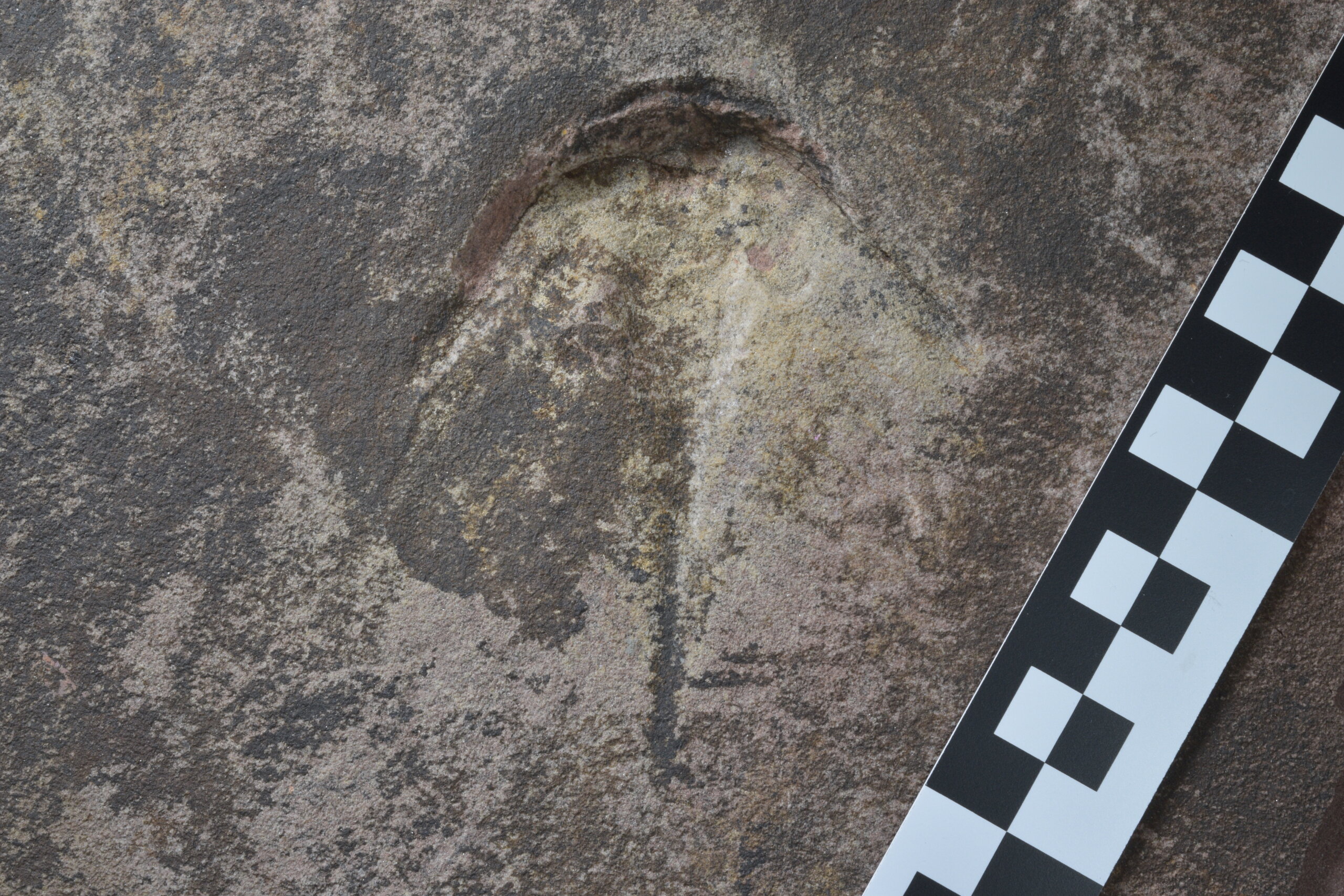
The new study is based on two horseshoe crab specimens from the Lower Triassic of the Holy Cross Mountains, preserved in deposits formed approximately 250 million years ago in a brackish lagoon or delta. Based on gypsum and latex casts, the researchers conducted a detailed morphological analysis of the material. Comparison of the new forms with previously known Triassic horseshoe crabs allowed the authors to establish a new genus and species within Austrolimulidae, named Polonolimulus zaleziankensis. Analysis of carapace shapes revealed significant similarity between Polonolimulus and the most “extreme” forms known from Australia and North America.
A palaeobiogeographic reconstruction of Triassic sites revealed a very wide distribution of horseshoe crabs already in the Early Triassic, largely along the coasts of the supercontinent Pangea. The surprisingly extensive range of austrolimulids at the very beginning of the Mesozoic, shortly after the Permian–Triassic mass extinction, may indicate either a very rapid diversification of this group in the Early Triassic or its origin already in the Late Permian.
The wide distribution of these “extreme” forms, sediments indicating a brackish habitat of Polonolimulus, and the reconstructed positions of all Triassic horseshoe crab localities within or near shallow marine environments may suggest connections of these animals with marine settings, casting doubt on the proposed colonization of fully freshwater habitats by austrolimulids.
The article entitled “A new Triassic austrolimulid from Poland presents insight into xiphosurid evolution and palaeobiogeography at the dawn of the Mesozoic” has been published in the scientific journal PeerJ.
The paper was co-authored by Dr Russell D. C. Bicknell (American Museum of Natural History, University of New England, and Flinders University of South Australia) and Dr Grzegorz Niedźwiedzki (Uppsala University and the Polish Geological Institute – National Research Institute).
The research was funded by the Polish National Science Centre (grant PRELUDIUM BIS no. 2022/47/O/NZ8/02934) and used equipment funded through I.3.4 Action of the Excellence Initiative – Research University Programme at the University of Warsaw (Project PARADIVE to dr hab. Kenneth De Baets, prof. ucz.). Contribution of Dr. Russell D. C. Bicknell was supported by the MAT Program Postdoctoral Fellowship and Australian Research Council grant DE250100256.
Link to the article: https://doi.org/10.7717/peerj.20950
Fot. Jonatan Audycki, Grzegorz Niedźwiedzki


