


Do unevenly distributed resources increase “inequality” among fish?
23 04 2026
In nature, food is rarely distributed evenly and most often occurs in patches. It turns out that such environmental heterogeneity can have surprising consequences not only for how much organisms eat, but also for how strongly they differ from one another.
An international research team, including scientists from the Department of Hydrobiology, Faculty of Biology, University of Warsaw, has published a paper in Proceedings of the Royal Society B entitled “Uneven resources, uneven fish: zooplankton patchiness drives variability in fish growth and metabolism.”
The study showed that when food (zooplankton prey) is distributed unevenly, juvenile fish rapidly aggregate into prey-rich patches. Importantly, such a spatial arrangement does not produce a consistent increase in mean foraging rate or improve cohort-level growth, but it does lead to markedly greater inter-individual variability.
Fish reared under patchy prey distribution differed more strongly from one another in standard metabolic rate and body-size traits than fish kept under homogeneous conditions. This means that the spatial structure of resources can increase within-cohort heterogeneity — even when initial prey delivery remains the same.
This is an important finding because it shows that not only the quantity of food, but also its spatial configuration, can shape organismal performance and, in consequence, influence population dynamics and trophic interactions.
Could similar mechanisms operate in other ecosystems as well — and might they affect the evolution of organismal traits? Answers to these questions may change the way we understand how environmental heterogeneity shapes biological diversity.
The authors from the Faculty of Biology, University of Warsaw are Dr Piotr Maszczyk (corresponding author), Marcin Lukasz Zebrowski, Maria Wierzbicka, Katarzyna Maja Rutkowska, Dr Qi Liu and Dr Ewa Babkiewicz (last author).
Article link: https://doi.org/10.1098/rspb.2026.0119
Fot. 1. The experimental setup used in the study. The photograph shows the research group leader, Dr Piotr Maszczyk.

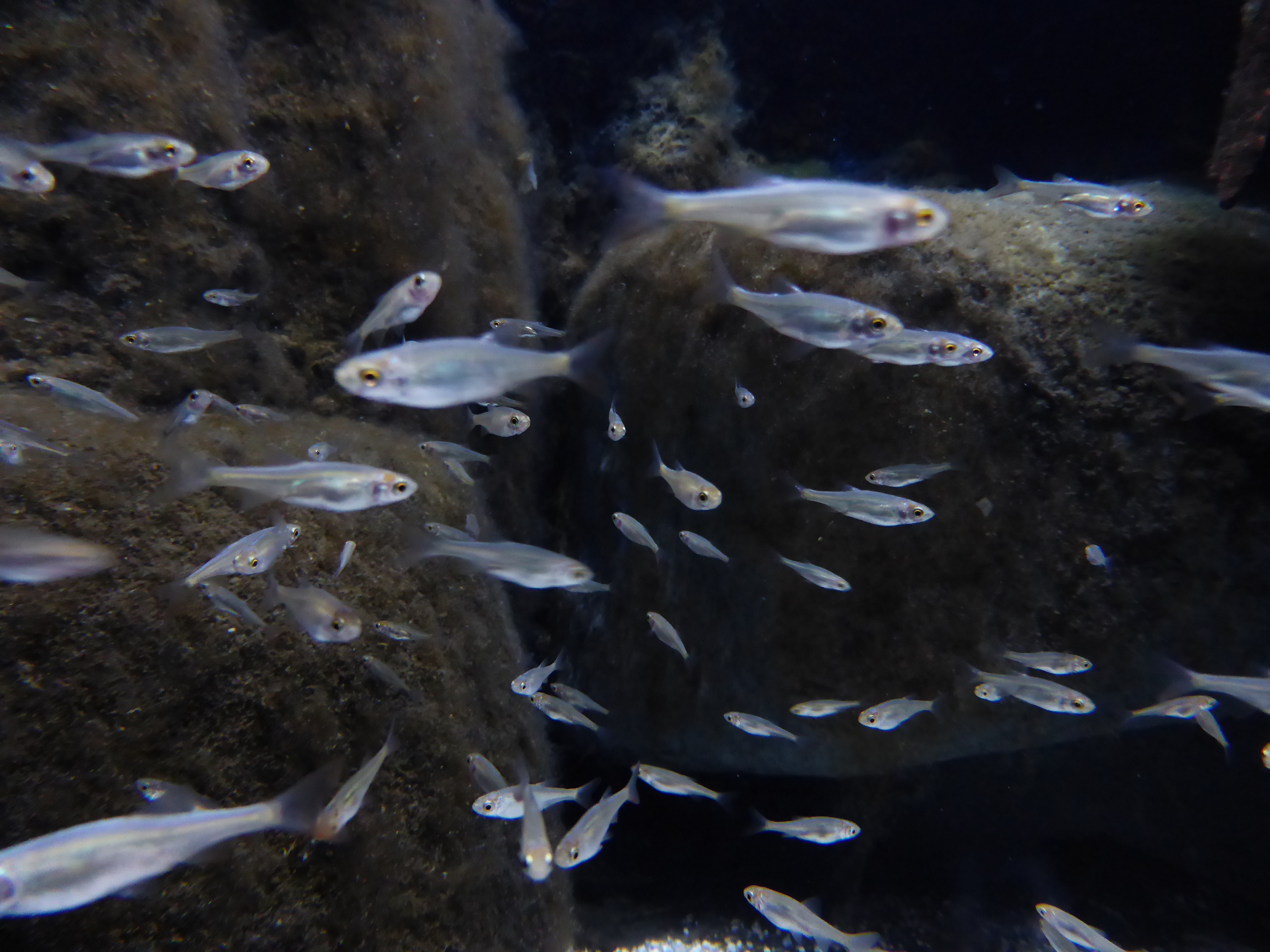
Fot. 2. Juvenile rudd (Scardinius erythrophthalmus) in an aquarium (photo: Martin Thoma; Wikimedia Commons).