

Forest management shapes the diversity of bryophytes
26 05 2026
New research conducted with the leading participation of scientists from the Faculty of Biology, University of Warsaw, shows that forest management affects not only the number of bryophyte species, but also the functioning of entire bryophyte communities. In the old-growth forests of the Białowieża National Park, mosses and liverworts were clearly more diverse than in managed forests of Białowieża Forest, and their traits indicated greater availability of moist, stable and heterogeneous microhabitats.
Although bryophytes often go unnoticed by forest visitors, they contribute significantly to the biodiversity of forest ecosystems. They grow on tree bark, deadwood, soil, litter and rocks, and their presence depends on moisture, light, substrate properties and the continuity of forest microenvironments. Because they respond rapidly even to subtle changes in conditions, they make it possible to detect what cannot be seen from the tree stand alone: the fine-scale structure of the forest, its history and the degree to which it has been transformed by human activity.
The researchers compared bryophyte communities in the Białowieża National Park and managed part of Białowieża Forest. They recorded mosses and liverworts growing on different substrates, assessed their frequency of occurrence, and then analysed both taxonomic diversity and functional traits, such as growth form, life strategy, and ecological preferences related to light, moisture and substrate nutrient content.


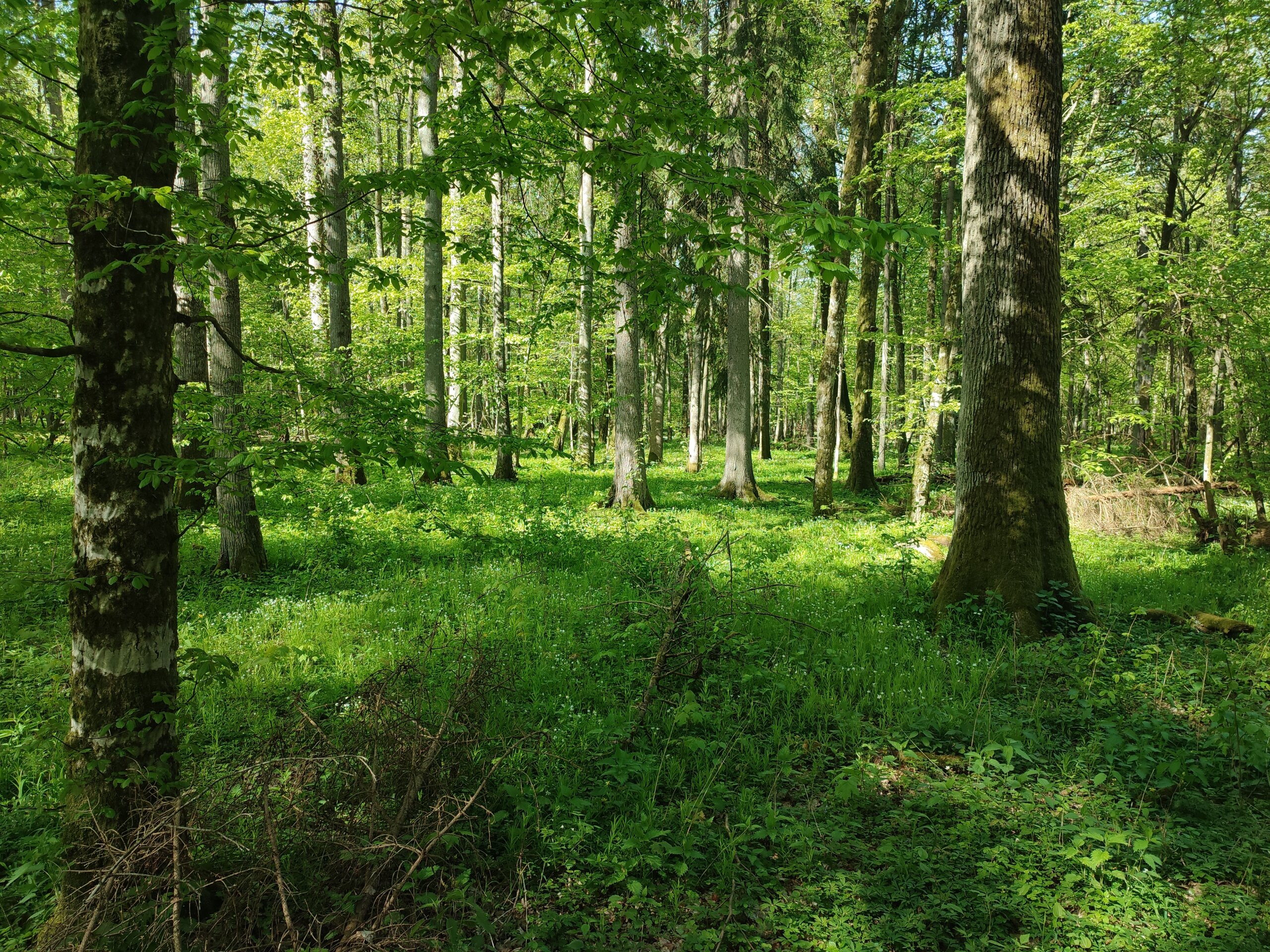
Photo: Bryophytes in the Białowieża Forest form diverse microhabitats on soil, deadwood and at the bases of trees. Their presence and species composition are important indicators of forest conditions, including moisture, light availability and the degree of ecosystem naturalness.
In total, 126 bryophyte species were recorded. In old-growth forests, mean species richness was approximately 60 percent higher than in managed forests. The differences also concerned community composition. Old-growth forests hosted more species associated with moist and stable microhabitats, while managed forests had more homogeneous communities, with a higher share of species tolerant of disturbance, greater light availability and less stable conditions.
The authors interpret these results as a consequence of differences in microhabitat availability. In old-growth forests, veteran trees, deadwood, uprooted trees, natural canopy gaps and complex forest structure create a mosaic of conditions in which many species can find their own niche. In managed forests, habitat filtering plays a stronger role, meaning that mainly species capable of functioning under a narrower range of conditions are able to persist. The study therefore shows that only by understanding the precise impact of human activity on all elements of forest ecosystems will it be possible to better protect forests and manage them sustainably.
The article “Forest management shapes functional and taxonomic diversity of bryophytes in temperate forests” was published in Forest Ecology and Management. The authors affiliated with the Faculty of Biology, University of Warsaw, are MSc Marcin T. Mazurkiewicz, Dr Patryk Czortek and Prof. Bogdan Jaroszewicz from the Białowieża Geobotanical Station of the Faculty of Biology, University of Warsaw, together with researchers from Jan Kochanowski University in Kielce and Wrocław University of Environmental and Life Sciences. Link to the publication: https://doi.org/10.1016/j.foreco.2026.123856.
Visit the official profile of the Białowieża Geobotanical Station https://www.facebook.com/BSGUW