


Do tits change their plumage colouration in response to urbanization?
22 04 2026
Urbanization transforms not only the landscape, but also the living conditions of animals that have learned to function in cities. Although many bird species occur at high densities in urban areas, life in such environments is often associated with poorer condition and lower reproductive success. Recent research shows that traces of these changes can be detected even in birds’ plumage, more specifically in the quality and intensity of its colouration, which can serve as an important biological signal.
Some colourful plumage ornaments are thought to function as so-called honest signals, informing potential mates about an individual’s health or quality. Their expression may also be influenced by the quality of the environment in which a bird lives during moult, that is, the periodic replacement of feathers that takes place once or twice a year.
For many years, populations of great tits across Europe have been reported to show the urban dullness phenomenon. This refers to less saturated yellow breast colouration in birds from urban habitats compared with individuals from forest populations. Among the proposed causes of this pattern is reduced availability of high-quality food, especially invertebrates and particularly caterpillars, which are the main source of carotenoid pigments responsible for yellow colouration in tits. At the root of the problem lies the limited availability of natural habitats in cities, while pollution and the urban heat island effect may further aggravate it by reducing the availability of invertebrates even more.


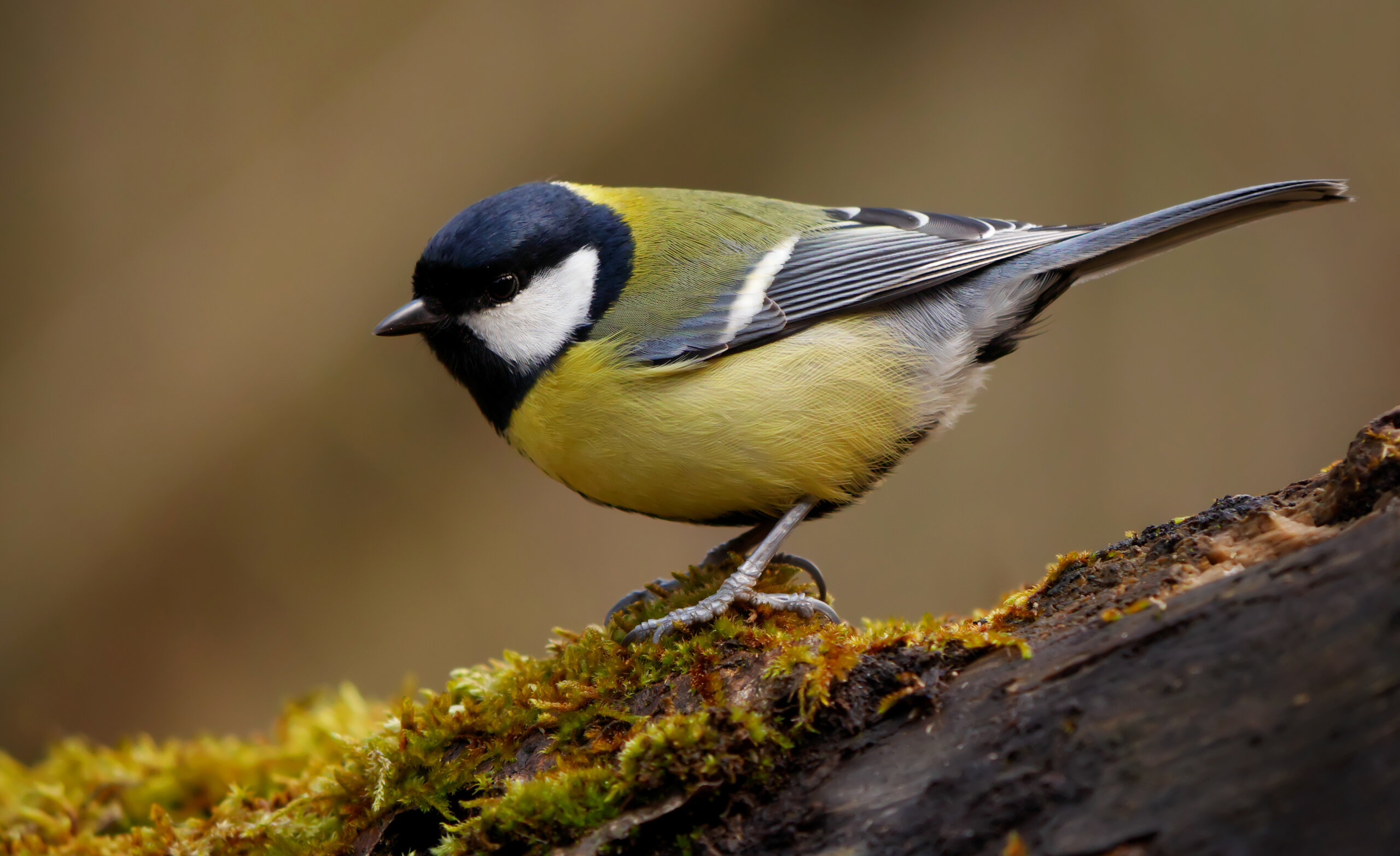
Fig. 1. Adult individuals of the two tit species studied: the great tit (right, Parus major; photo by Frank Vassen, Brussels, Belgium) and the blue tit (left, Cyanistes caeruleus; photo by Sławek Staszczuk).
In the present project, the researchers expanded the analysis to include other plumage traits, such as the dark, melanin-based breast tie of great tits and the blue wing and tail feathers of blue tits with structural colouration. They also accounted for the mosaic character of urban environments, in which densely built residential or industrial areas are interspersed with parks and river corridors. To do so, birds were studied along a gradient of habitats with increasing urbanization intensity, measured as the percentage of land covered by impervious surfaces such as asphalt, concrete, and buildings. In total, plumage colouration was analysed in birds from 44 locations across eight Polish cities: Białystok, Katowice, Łódź, Toruń, Lublin, Poznań, Wrocław, and Warsaw.
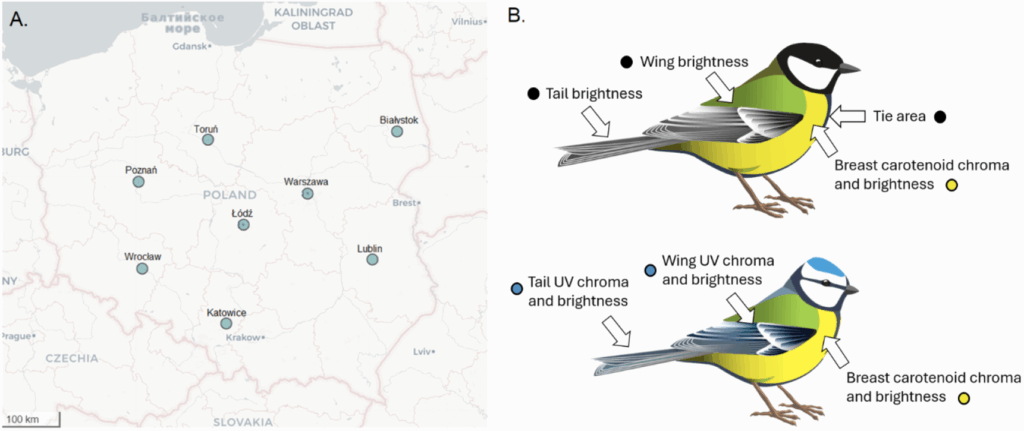
Fig. 2. A – Map of the cities where great tits and blue tits were captured in different urban and non-urban habitat types. In each location, birds were studied at 4–13 sampling sites. B – Diagram showing from which parts of the plumage feathers were collected for analysis and which types of colouration were assessed: melanin-based, carotenoid-based, and structural. Source: Janas et al. (2026), Replicated urban mosaics reveal trait- and species-specific shifts in carotenoid and structural plumage colouration of two passerines, Scientific Reports.
The researchers not only confirmed the presence of urban dullness in great tits in Polish cities, but also identified an interesting pattern within this trait. The intensity of yellow colouration was negatively correlated with the extent of impervious surface cover, or, in more colloquial terms, with the degree of urban sealing. In addition, great tits from more urbanized sites showed greater variation in the saturation of their yellow feathers. This is an important observation, because the level of variation in a trait within a population is one of the factors influencing the rate at which it can evolve. The result therefore suggests that carotenoid-based colour traits in urban birds may be subject to faster microevolutionary change.
Particularly interesting is the fact that the urban dullness phenomenon was found in the great tit, but not in the closely related blue tit. Although both species belong to the same family, occur in similar habitats, display many similar behaviours, and their yellow colouration is based on the same pigments, lutein and zeaxanthin, their response to urbanization turned out to be different. In blue tits, only slight differences in the brightness of yellow feathers were detected, whereas their saturation was not related to the degree of urbanization. This result shows that great caution is needed when extrapolating findings on the effects of urbanization even to closely related and ecologically similar species.
In the blue tit, the researchers also examined the structural blue colouration of the tail and wing feathers. They found that tail feathers were significantly brighter in more urbanized habitats, which may reflect a greater contribution of lower-quality food in the birds’ diet during moult. In contrast to structural and carotenoid-based colouration, no relationship was detected between the degree of urbanization and melanin-based colouration.
These findings show that patterns of response in avian colour traits to urban conditions are species-specific and differ depending on the type of colouration involved. On the one hand, such changes may provide valuable information about environmental quality. On the other hand, especially when studied over longer time periods, they may reveal complex mechanisms of adaptation to life in urban environments.
The article entitled “Replicated urban mosaics reveal trait- and species-specific shifts in carotenoid and structural plumage colouration of two passerines” was published in the international journal Scientific Reports. The last author of the paper is Prof. Marta Szulkin from the Anthropocene Biology Laboratory, Institute of Evolutionary Biology, Faculty of Biology, University of Warsaw. The study was funded by the Polish National Science Centre through a Sonata Bis grant no. 2014/14/E/NZ8/00386, led by Prof. Marta Szulkin.
Article link: https://doi.org/10.1038/s41598-026-44382-y