
Special Przewroty 2026 Award for Dr hab. Julia Pawłowska
26 05 2026
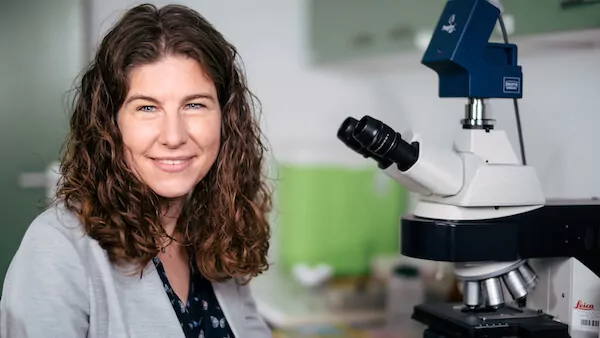
Dr habil. Julia Pawłowska from the Faculty of Biology, University of Warsaw, has received the Special Przewroty 2026 Award, granted by the Copernicus Science Centre. She received the distinction ex aequo with Dr habil. Tomasz Sulej, Prof. IPal PAS, for their pioneering activities in developing citizen science at the Copernicus Science Centre.
As Irena Cieślińska, Programme Director of the Copernicus Science Centre and Chair of the Special Award Committee, emphasised in her laudation, the award honoured “two people who reminded us that science begins with wonder. And that this wonder does not have to belong exclusively to professional researchers.”
The award was granted, among others, for the development of the “Genetic Mushroom Hunting” workshops, carried out by the Copernicus Science Centre in cooperation with the Institute of Evolutionary Biology, University of Warsaw, as part of the international FunDive project. The initiative combines research on fungal diversity with citizen science, engaging participants in real research activities such as isolating DNA from fungal samples, and entering results into a pan-European database.
The FunDive project addresses an important knowledge gap concerning the distribution and threat status of fungi in Europe. Thanks to cooperation between scientists, educators and mushroom-picking enthusiasts, it is possible to collect data needed to better understand and protect fungal biodiversity. In the project, Dr habil. Julia Pawłowska coordinates citizen science activities.
More information about the recipients of the Przewroty 2026 Award is available in the Nauka w Polsce article:
The “Genetic Mushroom Hunting” project and the discovery of new fungal species thanks to the involvement of mushroom-picking enthusiasts were also covered by Nauka w Polsce and National Geographic Polska:
- https://naukawpolsce.pl/aktualnosci/news%2C112865%2Cmykolozka-dzieki-grzybiarzom-odkryto-trzy-nowe-gatunki-grzybow-nauka
- https://www.national-geographic.pl/przyroda/polska-w-czolowce-badan-nad-grzybami-grzybiarze-pomogli-odkryc-trzy-nowe-gatunki/
We warmly congratulate Dr habil. Julia Pawłowska on this exceptional distinction and on the recognition of activities showing that science can be beautiful, fascinating, open, engaging and co-created also by people from outside the academic community.