


Microplastics can reduce the abundance of planktonic crustacean populations without altering their clonal structure
07 07 2026
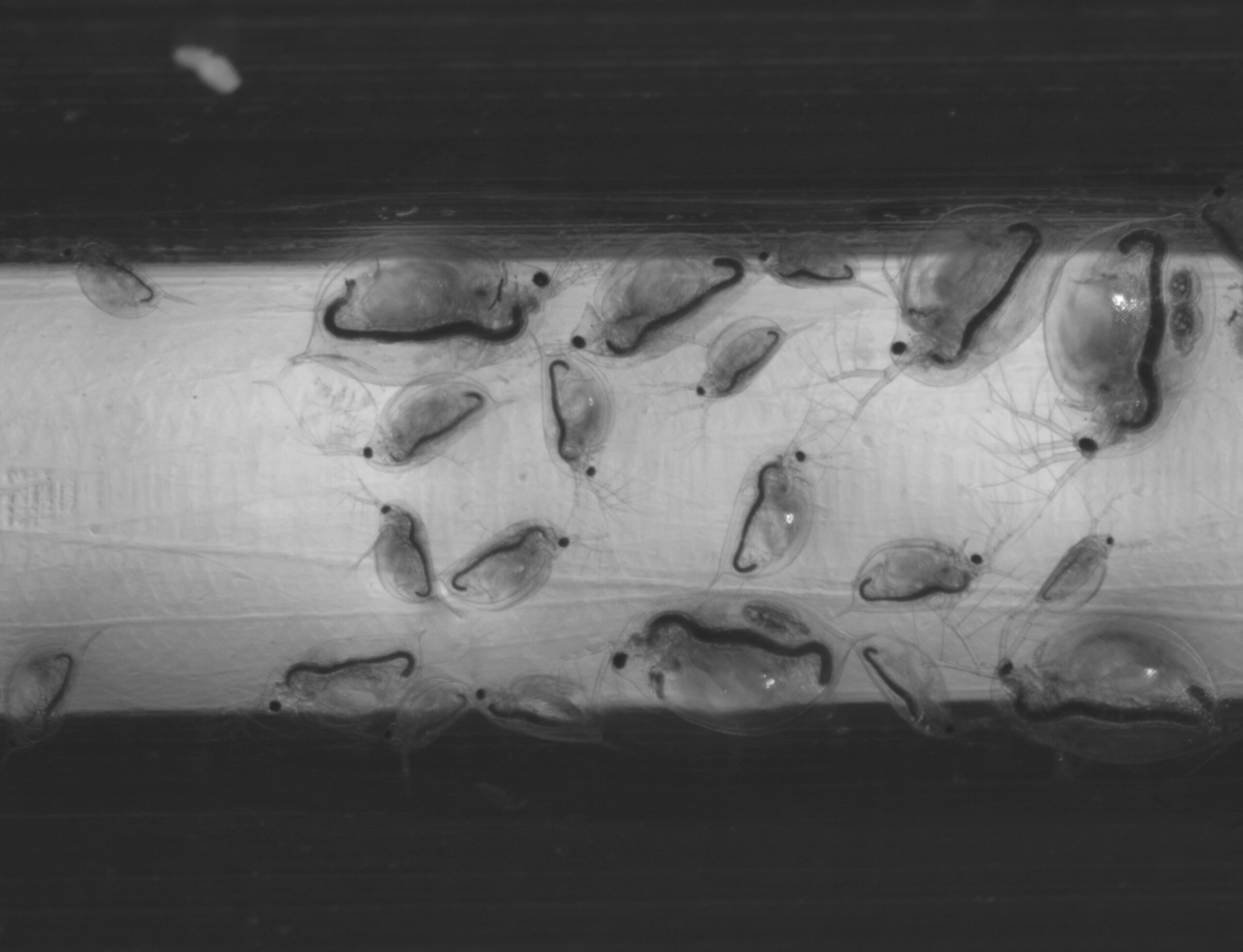
Microplastics can reduce the abundance of Daphnia populations, small, filter-feeding planktonic crustaceans that play an important role in freshwater ecosystems, before causing detectable changes in the frequencies of individual genotypes. This is indicated by research on Daphnia pulex populations conducted by scientists from the Faculty of Biology at the University of Warsaw.
The study used six D. pulex clones collected from small water bodies in southern Masuria. The Daphnia clones, or genotypes, were distinguished using allozymes—slightly different variants of the same enzyme that can be compared to a biochemical “fingerprint”. The clones were arranged into three pairs, each comprising one clone from a forest pond and one from a village pond. The researchers assumed that genotypes originating from environments exposed to stronger anthropogenic pressure might exhibit greater general stress tolerance and, consequently, lower sensitivity to microplastics. Six independent 30-day experiments were conducted. In the experimental treatment, a mixture of spherical polystyrene particles measuring 1 and 25 µm in diameter was added to the water in which the Daphnia were cultured. The particles were similar in size to their food, including bacteria and unicellular algae.
In two of the three clone pairs, microplastics reduced the densities of both adult and juvenile individuals. However, no effect was found on the density of gravid females or mean clutch size. After 30 days, microplastics did not alter clone proportions, and the hypothesis that clones from village ponds would have an advantage was not confirmed. The findings therefore suggest that demographic changes may precede shifts in clonal structure, which may require longer, multigenerational experiments conducted under variable environmental conditions and additional stressors to detect.
The article “Microplastics reduce population viability without shifting clonal structure in Daphnia pulex” was published in Ecotoxicology and Environmental Safety. The authors affiliated with the Faculty of Biology at the University of Warsaw include Marcin Łukasz Żebrowski, MSc, Natalia Sipa, Dr Ewa Babkiewicz, Prof. Mirosław Ślusarczyk and Dr Piotr Maszczyk.
The research was funded by the National Science Centre OPUS 18 grant (2019/35/B/NZ8/04523), entitled “The impact of microplastics on selected ecological interactions between aquatic organisms” and led by Dr Piotr Maszczyk, as well as by the Young Researchers Project of the Faculty of Biology at the University of Warsaw and the Excellence Initiative – Research University programme.
Link to the publication: https://doi.org/10.1016/j.ecoenv.2026.120200