
€4.6 million for the QuBiD Joint Master’s Programme: University of Warsaw to lead a European consortium

14 07 2026
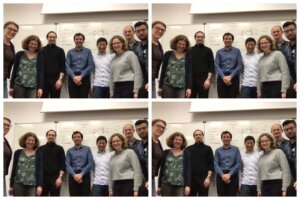
The Quantitative Biodiversity (QuBiD) project, led by Dr Sergi López-Torres from the Faculty of Biology at the University of Warsaw, has been awarded €4.6 million in funding under the Erasmus Mundus Joint Masters programme. This marks the first time that the University of Warsaw will lead a consortium delivering an Erasmus Mundus Joint Master’s programme.
QuBiD is an international, interdisciplinary study programme dedicated to quantitative biodiversity research. It will be jointly developed and delivered by six European universities. In addition to the leader, i.e.,University of Warsaw, the partner institutions are:
- the University of Milan,
- Charles University in Prague,
- the University of Copenhagen,
- the University of Tartu,
- Sorbonne University.
Five of the six universities are members of the 4EU+ Alliance, and the development of the programme is one of the outcomes of their ongoing collaboration within the Alliance.
Biology and advanced data analysis methods
The QuBiD programme will combine a strong foundation in ecology and evolutionary biology with advanced digital methods, including bioinformatics, modelling, artificial intelligence and big data analysis.
Students will acquire the skills needed to study biodiversity across different temporal and spatial scales. They will learn to analyse complex biodiversity data while gaining practical experience through laboratory classes, fieldwork and participation in international research teams.
The programme will also address the European and global policy context of environmental protection, including the objectives of the EU Biodiversity Strategy for 2030. QuBiD graduates will be prepared to tackle challenges related to biodiversity conservation, support evidence-based environmental policymaking, and contribute to biodiversity monitoring and reporting.
“The launch of the QuBiD programme is a success of the collaboration within the 4EU+ Alliance, demonstrating that partnerships between European universities enable the effective transfer of knowledge, experience, and best practices in the development of innovative study programmes. It is a unique opportunity to establish a new field of education in the area of quantitative biodiversity research, a programme with a distinctive profile that currently has no equivalent in Europe.” says Dr Sergi López-Torres, programme coordinator at the Faculty of Biology, University of Warsaw.
Studying at three European universities
International mobility will be an integral part of the QuBiD programme. Each student will study at three European universities during the course of the programme.
The first semester will take place at the University of Warsaw and the second at the University of Milan. During the second year, students will choose one of four specialisation tracks:
- Biodiversity & Evolution at Charles University,
- Biodiversity, Ecosystem Dynamics & Global Change at Sorbonne University,
- Community Ecology & Conservation at the University of Copenhagen,
- Biodiversity Informatics & Taxonomy at the University of Tartu.
This structure will give students access to the expertise, research infrastructure and experience of several academic centres, while also allowing them to explore different ecosystems and approaches to biodiversity research.
Broad international support
The project has received the support of eight associated partners and 29 institutions and organisations from Europe and other parts of the world. These include the Natural History Museum at the University of Oslo, the American Museum of Natural History, WWF Poland and the South African National Biodiversity Institute.
Two other 4EU+ Alliance member universities have also supported the development of the programme: the University of Geneva as an associated partner and Heidelberg University as a supporting stakeholder.
The project proposal received a very high evaluation score of 90 out of 100 points. The programme is expected to launch in the 2027/2028 academic year and admit up to 40 students annually.
Congratulations to Dr Sergi López-Torres and the entire team involved in developing the project!