


Glowing pollen under the microscope: does it change bee behaviour?
15 06 2026
Pollination is one of those processes that take place almost unnoticed, yet sustain the life of entire ecosystems. The reproduction of many wild plant species, crop yields, and the stability of relationships between plants and animals all depend on effective pollen transfer. However, the mere presence of insects on flowers is not enough to understand this process. An insect may visit a flower without successfully transferring pollen to the stigma of another plant. This is why researchers have long been looking for methods that make it possible to track not only pollinator visits, but also the actual path of pollen.
This is the problem addressed in a study in which scientists from the Faculty of Biology tested whether one of the most interesting methods for tracking pollen may itself affect insect behaviour. The method involves quantum dots, very small glowing markers attached to pollen grains. They allow researchers to see where pollen is carried after a visit by a bee or another pollinator.
Until now, it had not been clear whether labelling pollen with quantum dots is entirely neutral for insects. The method seemed highly promising because it allows individual pollen grains to be tracked in the field, without relying on more problematic approaches such as radioactive tracers or less precise dyes. In practice, however, quantum dots are applied to pollen in a volatile solvent, hexane. It was assumed that hexane evaporates quickly and does not influence pollinator behaviour. The authors set out to test precisely this assumption.
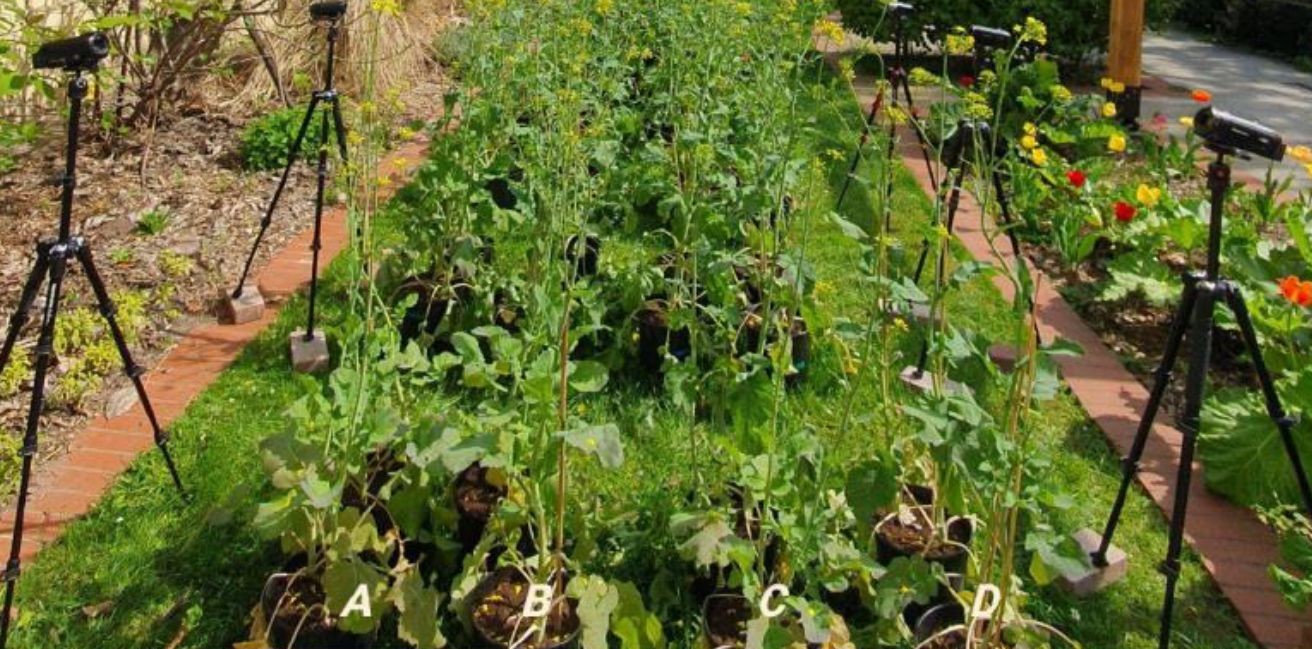
The experiment was carried out in the University of Warsaw Botanic Garden using genetically uniform plants of oilseed rape, Brassica napus, cultivar Monolit. The researchers compared insect interest in untreated flowers, flowers treated with hexane only, and flowers labelled with quantum dots suspended in hexane. Insect activity was recorded with cameras and later analysed in terms of how often pollinators visited the plants, how many flowers they visited during a single foraging bout, and how long they remained on individual flowers. The observed pollinators were dominated by honeybees and solitary bees.
Insects visited control plants more often than plants whose pollen had been exposed to hexane or to a quantum-dot solution in hexane. Different colours of quantum dots did not cause significant differences in insect behaviour.
The results indicate that although quantum dots themselves do not deter insects, the hexane used to apply them may do so. For a bee, a flower is not simply a patch of colour, but a set of signals: colour, scent, taste, and information about a reward, such as nectar or pollen. Hexane may have altered the scent of pollen, affected its taste, or changed the way anthers reflected light. Even if it evaporates quickly, it may have briefly disturbed these signals enough to change insect behaviour. The practical conclusion for future research is straightforward: quantum dots remain a useful tool for tracking pollen transfer, but experiments using them should always include a solvent-only control.
The publication “When methods matter: solvent effects on pollinator responses to quantum-dot-labeled pollen” appeared in the journal Plant Methods. The authors are Barbara Płaskonka, MSc, Prof. Marcin Zych, PhD, DSc, Maria Woszczenko, and Katarzyna Roguz, PhD Eng., from the Botanic Garden of the Faculty of Biology, University of Warsaw, in collaboration with researchers from the Plant Breeding and Acclimatization Institute in Radzików. The study was funded under the Excellence Initiative – Research University programme implemented at the University of Warsaw.
Link to the publication: https://doi.org/10.1186/s13007-026-01544-3
We warmly congratulate the authors and wish them continued scientific success!