


Can fossil burrows of lungfish help determine climatic conditions in the Late Triassic?
13 03 2026
Dr Wojciech Pawlak (first author) and Dr Mateusz Tałanda are co-authors of the scientific paper entitled “High-latitude dipnoan aestivation burrows suggest seasonal aridity for early dinosaur ecosystems in the Late Triassic of East Greenland”. The study focuses on how fossil aestivation burrows, that is underground shelters that help animals survive unfavorable environmental conditions, can be used to reconstruct the Triassic palaeoenvironment. The article was published in Palaeogeography, Palaeoclimatology, Palaeoecology.
Among paleontologists, there is an ongoing debate about whether the migration of early long-necked sauropodomorph dinosaurs across high latitudes was facilitated by the relatively humid climate of northern Pangaea. A key region for resolving this question is the Jameson Land Basin in eastern Greenland, owing to its position between Europe and North America and the richness of its Late Triassic faunal record.
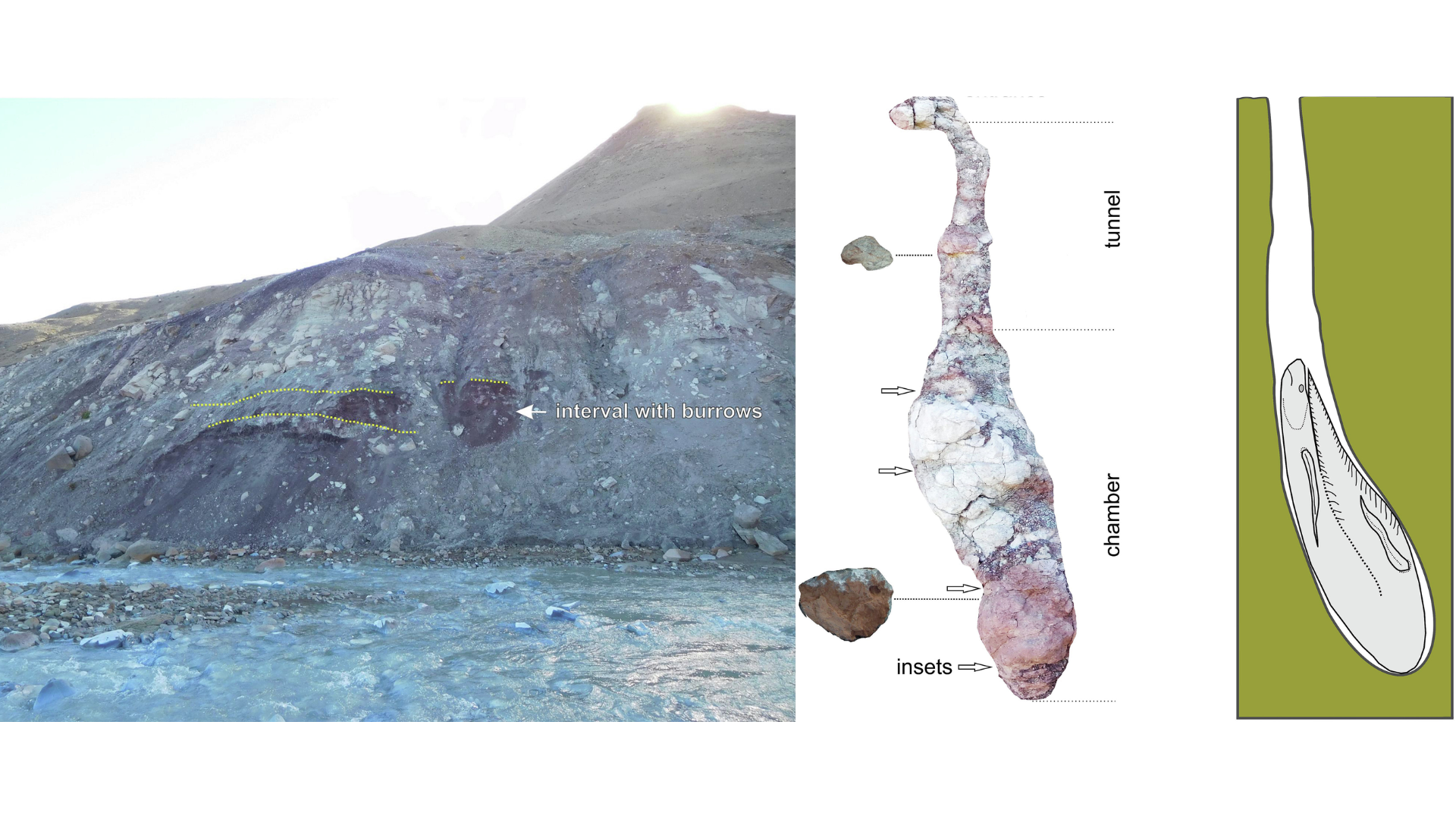
Some researchers explain the appearance of sauropodomorphs in Greenland by a shift of the region into a more humid climate belt, whereas other point to persistently dry conditions. The aim of the study was to interpret and describe newly identified burrow structures in the Jameson Land Basin and assess whether they were made by lungfish. Such burrows can be an important clue about palaeoclimate, because they usually form when drought is approaching.
The recovered fills of the terminal chambers of the burrows were described morphologically, compared with data from studies of modern lungfish and with the fossil record of known aestivation burrows, and their age was determined. In addition, one specimen was cross-sectioned to assess the internal structure of the infill and sediment deformation traces related to the animal’s behavior inside the chamber.
The analyzed burrows do not show typical traces of digging with limbs that are characteristic of many vertebrates, there are no clear scratches or grooves on the walls, and they also do not have a complex architecture. Features such as the relationship between shaft diameter and chamber width, single traces that may correspond to fin movement, as well as deformations suggesting a U-shaped body position, support the interpretation that these structures were shelters made by lungfish.
The work by Pawlak and colleagues supports the hypothesis that in East Greenland, during the Late Triassic, the climate remained at least seasonally dry, with the water body drying out periodically, despite an overall trend toward higher humidity. In addition, the study suggests that environmental drying did not block the migration of sauropodomorphs and theropods, these animals may have migrated to the region seasonally or were adapted to periodic droughts.
The study was carried out in collaboration with Dr hab. Tomasz Sulej (Department of Evolutionary Paleobiology, Institute of Paleobiology, Polish Academy of Sciences), Prof. Martin Qvarnström (Uppsala University), and Dr Grzegorz Niedźwiedzki (Uppsala University and the Polish Geological Institute, corresponding author).
The study was made possible through support from the National Science Centre, Poland (grant 2012/07/B/NZ8/02707), the Swedish Research Council (grant 2017-05248), the European Research Council (grant ERC-2025-STG “DINO-DIGEST”, project no. 101222665), and a scholarship from the Foundation for Polish Science.
We warmly congratulate the authors on this very interesting research and wish them further scientific success.
Link to the publication: https://doi.org/10.1016/j.palaeo.2026.113624