

How has climate shaped the evolution of plant pollen? New research by UW scientists
11 02 2026
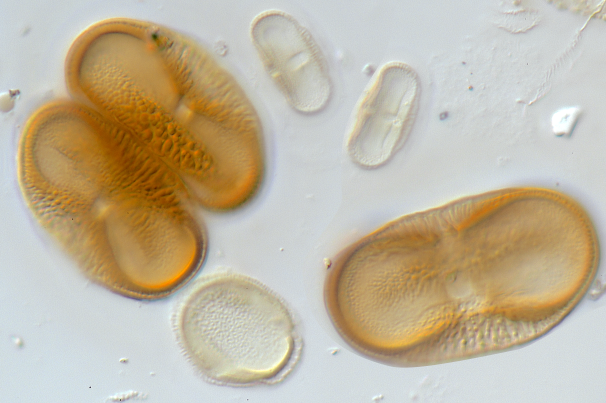
Researchers from the Institute of Evolutionary Biology, Dr Jakub Baczyński, Dr Łukasz Banasiak, and Prof. Krzysztof Spalik, in collaboration with Prof. John M. Burke (University of Georgia, Athens, USA), have published a study in New Phytologist entitled “Climate adaptation and functional constraints drive pollen evolution in Apiales”, examining the factors shaping the evolution of pollen morphology in the order Apiales.
Pollen grains are among the most durable biological structures and are often exceptionally well preserved in the fossil record, sometimes providing the only evidence of past plant diversity. For this reason, understanding macroevolutionary patterns of variation in pollen morphology is important for research on plant diversification and for estimating divergence times among major evolutionary lineages.
The authors analysed pollen trait evolution across Apiales, which includes the Apiaceae (e.g., carrot, celery, parsley) and the Araliaceae (e.g., ivy, schefflera). While early-diverging lineages are mainly associated with tropical and subtropical climates, Apiales underwent extensive adaptive radiation in the Northern Hemisphere, especially in temperate and Mediterranean regions, where the group is most diverse today. The study tested whether transitions between these climatic regimes are linked to changes in pollen structure.
Evolutionary modelling and phylogenetic comparative analyses indicate that climate has been a key driver of pollen morphology in extant Apiales. Selection favoured traits reducing water loss, including a reduced aperture and a thicker pollen wall. The study also identified adaptive fetures shaped by biomechanical constraints related to controlled shrinking and swelling during transport from the anther to the stigma. These findings support the development of a theoretical framework for identifying fossil Apiales pollen.
The research was carried out under project no. 2014/15/D/NZ8/00286 funded by the National Science Centre (Poland).
The publication is available at:
https://nph.onlinelibrary.wiley.com/doi/10.1111/nph.70824
We encourage readers to explore the research activities of the Plant Phylogeny and Evolution Group at the Institute of Evolutionary Biology:
https://ibe.biol.uw.edu.pl/grupy-badawcze/filogeneza-i-ewolucja-roslin/
We would also like to remind that Dr Jakub Baczyński is currently recruiting students, a PhD candidate, and a postdoctoral researcher to work on a SONATA grant focused on the evo-devo of syncephalia in Asteraceae. Current calls are available at: