


Secrets Hidden in Wolf Teeth
17 02 2026
Scientists have confirmed the remarkable dietary flexibility of wolves and the strong impact of climate on what they eat. These conclusions come from the analysis of tiny wear marks on the teeth of fossil and modern predators from Europe.
The wolf is a large predator from the dog family that lives in family groups. Historically, this species occurred across the entire Northern Hemisphere, but deliberate extermination caused it to disappear from many regions. After decades of persecution, wolves have returned to almost all European countries thanks to legal protection. In Poland, the wolf has been strictly protected since 1998, which has allowed its population to recover across the country.
For many years, scientists have focused on understanding the interactions between wolves and their prey. Today, studies on how climate affects prey populations are becoming especially important, because changes in prey availability influence predator diets and feeding strategies. New insights have been provided by research carried out by a British-Polish team, including scientists from the Universities of Bristol and Leicester, the Natural History Museum in London, and specialists from the Faculty of Biology at the University of Warsaw. Their results have just been published in the scientific journal Ecology Letters.
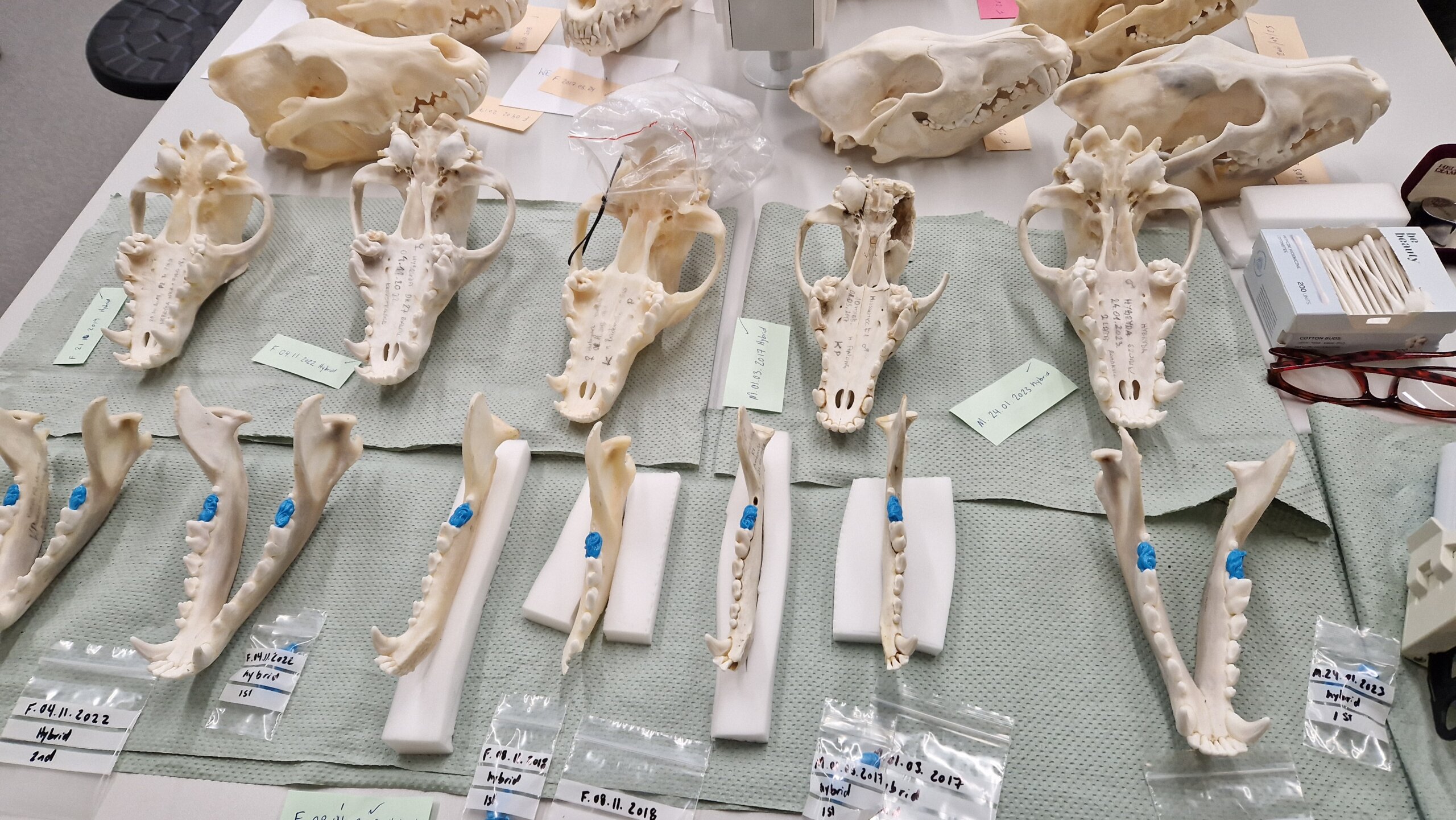
The researchers compared the teeth of several dozen fossil wolves from the British Isles with those of modern wolves living in Poland. They analysed the surface of the predators’ lower jaw premolars, looking for microscopic damage to the enamel. Such studies can show, among other things, how much hard food, such as bones, was present in the diet. The fossil wolves came from two interglacials, periods between ice ages, with different climate and environmental conditions.
The last interglacial, known as the Eemian (called MIS 5e in the marine isotope stage scale commonly used by paleobiologists), was a warm period. In the British Isles, average July temperatures were then 3 to 5°C higher than today. Forests were the dominant habitat, and prey available to wolves included forest elephants, narrow-nosed rhinoceroses, hippopotamuses, wild boar, giant deer, fallow deer, aurochs, and steppe bison.
In contrast, the climate of the earlier interglacial (MIS 7a–c) was much cooler. Large areas were covered by grasslands with scattered, open woodlands. Possible prey species at that time included mammoths, horses, steppe asses, and several species of fossil rhinoceroses.
The analyses showed that fossil wolves from MIS 7a–c ate much less hard food (bones) than wolves living during MIS 5e and modern wolves. This pattern suggests that wolf diets changed between interglacial periods. The researchers predict that further warming will reduce snow cover even more, which will have global consequences for ecosystems. Shorter winters will likely change wolf–prey dynamics, for example by increasing predation on some species and reducing the availability of carrion in winter, which may have negative consequences for scavengers.
“These results provide insight into long-term changes in wolf diets,” says Dr hab. Sabina Nowak, Professor at the Faculty of Biology, University of Warsaw, and President of the Association for Nature “Wolf”, a co-author of the study. “They show that wolves are flexible predators and can adapt to changes in the prey community,” she adds.
The British-Polish team’s work is another project showing major changes in ecological systems linked to climate change. The scientists emphasise that knowledge about these mechanisms should be included in species conservation plans.
The research was co-funded by the National Science Centre (NCN) OPUS grant titled Factors shaping the exposure of large predators to health threats along an urbanisation gradient, led by Dr hab. Sabina Nowak, Professor at the University of Warsaw.
The article is available at: https://doi.org/10.1111/ele.70337
Congratulations on the research results!