

Our researchers co-authors of a study on the impact of a parasitic fungus on work organization in ant colonies
04 02 2026
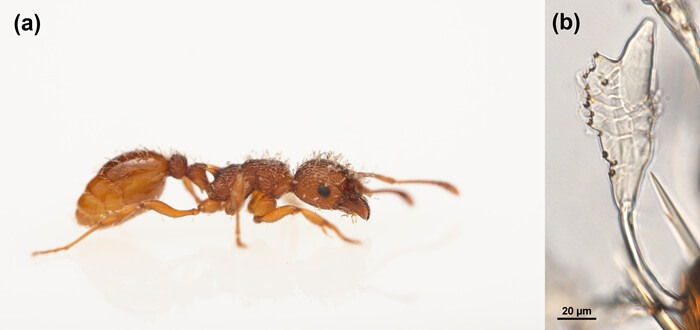
Michał Kochanowski from the Institute of Evolutionary Biology and the Botanical Garden, Faculty of Biology, University of Warsaw, is the lead author of a recent publication on the effects of chronic infection by a parasitic fungus on the functioning of colonies of the ant Myrmica scabrinodis. The paper entitled “Chronic fungal infection accelerates age polyethism in ants without altering immune response” was published in the journal Animal Behaviour. The co-authors also include Igor Siedlecki and Marta Wrzosek from the Botanical Garden of the Faculty of Biology, University of Warsaw.
Parasites in colonies of social insects, including ants, can spread relatively easily due to frequent contact between individuals that live together in the nest and engage in many interactions. The authors therefore investigated how chronic infection with the parasitic fungus Rickia wasmannii, an ectoparasite developing on the surface of the insects’ bodies and transmitted mainly through direct contact, affects the functioning of Myrmica scabrinodis colonies.
The aim of the study was to determine whether infection changes the rate at which worker ants switch to foraging outside the nest and whether selected immune parameters are more strongly influenced by the age of the workers or by the role they perform. Under laboratory conditions, workers from 20 colonies collected in the vicinity of Kraków, including both infected and uninfected colonies, were observed for 64 days. Young workers were individually marked and their activity was monitored, and the transition to foraging was defined as at least three observations of an individual outside the nest, allowing the researchers to estimate the age at which a worker begins this more risky role. Infection intensity was assessed by counting fungal structures on the bodies of workers from infected colonies.
The results showed that the intensity of infection, rather than its mere presence, was the key factor. In colonies more heavily burdened by the parasite, workers began leaving the nest and foraging earlier. The authors interpret this as an acceleration of age polyethism, meaning an earlier shift of workers to more risky tasks in response to chronic parasite pressure on the colony. It was also observed that workers from infected colonies were smaller, which is consistent with earlier findings linking infection to reduced body size.
At the same time, a selected component of immunity was examined by measuring the activity of the phenoloxidase system, an important element of innate immunity in insects. This enzyme is involved, among other things, in melanization reactions that help limit pathogen development and support wound healing. For this reason, the activity of phenoloxidase and its inactive form, prophenoloxidase, is often used as an indicator of immunological “readiness”. In this study, these parameters increased with worker age, but no significant differences were found between ants working inside the nest and those foraging outside when individuals of the same age were compared, suggesting that age had a stronger effect than task change during the analysed period.
The authors emphasize that relationships between colony role, investment in immunity and infection risk may be strongly species-specific and depend on which components of the immune system are measured.
This research is part of the project No. 2022/45/P/NZ8/04018 co-funded by the National Science Centre and the European Union Framework Programme for Research and Innovation Horizon 2020 under the Marie Skłodowska-Curie grant agreement No. 945339.
We congratulate the authors on these interesting results! The full article is available at: https://www.sciencedirect.com/science/article/pii/S0003347225003537?via%3Dihub