


Softshell turtles in Miocene Poland: a “tropical” surprise in the north
15 01 2026
A paper in the Journal of Anatomy, co-authored by Yohan Pochat-Cottilloux, Sergi López-Torres and Mateusz Tałanda from the Institute of Evolutionary Biology, Faculty of Biology, University of Warsaw, has just been published. The article is titled “First occurrences of Trionychidae (Testudines, Cryptodira) from the Miocene of Poland: Detailed cranial anatomy and biogeographic implications”. It focuses on softshell turtles, a group typical of tropical and warm climates, found in what is now Poland during the Miocene, about 12 million years ago.
Softshell turtles (family Trionychidae) are aquatic turtles that today occur mainly in tropical regions. An international team of palaeontologists report the first unquestionable fossils of softshell turtles from Poland. These findings fill an important gap in Europe’s Miocene record and push the group’s known range much farther north than previously documented. The presence of warm-adapted turtles in Poland about 12 million years ago suggests that local conditions still supported thermophilic animals, even though the climate was already cooling after the Mid-Miocene Climatic Optimum, which happened a few million years earlier.
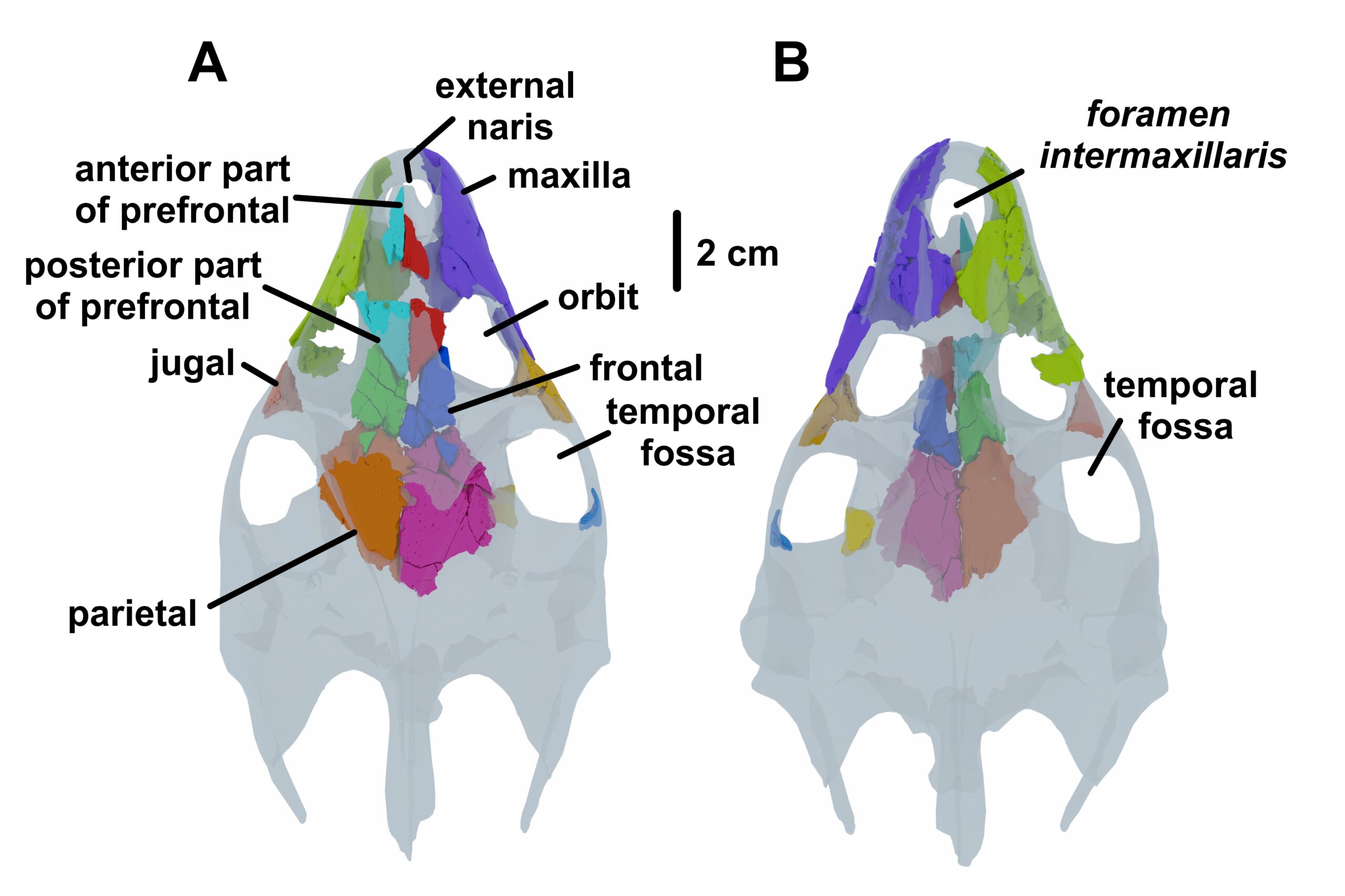
The fossils come from three Middle Miocene sites in southern Poland, near Kielce. They were preserved in sediments laid down as the ancient Paratethys Sea was retreating and coastal to river environments expanded. The material includes an incomplete skull, the most informative specimen, and shell fragments.
To “see inside” the skull without damaging it, the researchers used micro-CT scanning and then built 3D digital reconstructions of the preserved bones. The fossil skull anatomy was compared against a broad reference set, including dozens of modern softshell turtle specimens and key fossils. This made it possible to check which cranial traits are truly useful for identification, and which vary too much within species to be reliable. Based on skull features, the specimen is tentatively assigned to Trionyx cf. vindobonensis.
The results offer a new view on Miocene turtle biogeography in Europe. Earlier Miocene records from nearby areas, for example from what is now Czechia, were attributed to Rafetus, a different genus within the same family. This led to the idea of separate ranges for Trionyx and Rafetus in Europe. The Polish occurrence of Trionyx in the Middle Miocene challenges that hypothesis and suggests more dynamic range changes, and possibly ecological competition between these lineages over time.
This discovery is also an important clue about ancient migration routes. Because the fossils occur along the former northern margins of the Paratethys realm, the study suggests that the northern Paratethys coastline may have acted as a dispersal corridor for warm-adapted animals across Eurasia. The authors hope this idea can be tested in the future with additional findings.
Funding information: The research was funded by the Narodowe Centrum Nauki (National Science Centre, Poland) under grants OPUS No. 2022/47/B/ST10/02686 and 2023/49/B/ST10/02631, and the POLONEZ BIS programme No. 2022/45/P/NZ8/00600.
Full reference:
Pochat-Cottilloux, Y., López-Torres, S., Chroust, M., Georgalis, G. L., Górka, M., & Tałanda, M. (2026). First occurrences of Trionychidae (Testudines, Cryptodira) from the Miocene of Poland: Detailed cranial anatomy and biogeographic implications. Journal of Anatomy. https://doi.org/10.1111/joa.70095
Link to the article:
https://onlinelibrary.wiley.com/share/author/TXRUTRDEJEKYQ98XCFTB?target=10.1111/joa.70095