


Plants that move? A new publication from the Department of Plant Metal Homeostasis
04 12 2025
In their latest review article published in The Botanical Review, scientosts from the Institute of Experimental Plant Biology and Biotechnology, Faculty of Biology UW, Magdalena Pypka and Oskar Siemianowski, describe various types of plant movements, with particular emphasis on tropic responses. They analyze the potential mechanisms that enable directional changes in root growth, as well as the underlying molecular and signaling processes.
Movement is fundamental to the survival of organisms. While animals rely on sensory organs to move through their environment, plants – being sessile organisms – have evolved alternative strategies to explore their surroundings through changes in organ growth and morphology. Central to these processes are meristems, the continuously dividing tips of plant organs, and the elastic, modular cell walls, which allow plants to respond to environmental stimuli by locally adjusting growth rates.
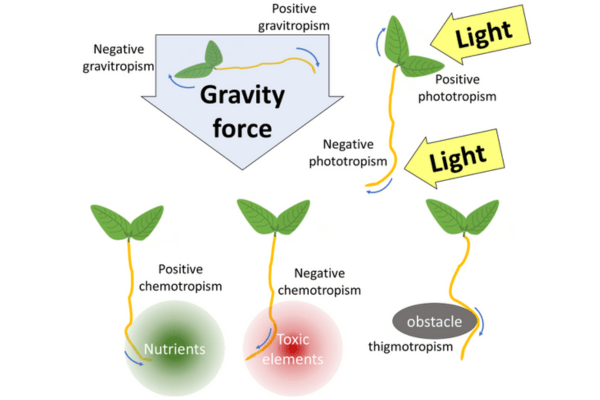
The authors highlight that tropisms – such as gravitropism, hydrotropism, and chemotropism – constitute key mechanisms by which plants sense external conditions and direct their growth accordingly. These responses are governed by a complex regulatory network involving hormonal signaling (including auxins, cytokinins, and ethylene), gene expression control, and specialized cellular structures such as statocytes and statoliths, which enable the perception of gravity and environmental gradients.
The publication pays particular attention to nutritropism – the directional growth of roots toward micro- and macronutrients whose distribution in soil is often heterogeneous. This relatively understudied phenomenon is gaining importance in the context of current challenges, including soil degradation, fluctuating moisture conditions, and the need for more sustainable fertilization strategies.
Understanding how plants perceive uneven distributions of water and nutrients, and how they integrate these hormonal and architectural signals, may contribute to improving crop biofortification, enhancing root system adaptation to climate-related stresses, promoting more efficient and sustainable fertilization practices.
We encourage you to read the full article:
https://link.springer.com/article/10.1007/s12229-025-09320-z