


Plants Can Redistribute Zinc Between Their Own Roots – Publication in BMC Plant Biology
03 12 2025
A team from the Department of Molecular Foundations of Metal Homeostasis in Plants (Institute of Experimental Plant Biology and Biotechnology, Faculty of Biology UW) led by DR Oskar Siemianowski in collaboration with researchers from the National Synchrotron Radiation Centre SOLARIS (Jagiellonian University), has published new findings on the mechanisms of zinc (Zn) distribution within the plant root system. The study has appeared in the journal BMC Plant Biology.
Zinc is essential for both proper plant development and human health, yet up to half of agricultural soils worldwide are deficient in this micronutrient. While the effects of heterogeneous distribution of macronutrients in soil on plant growth have been extensively studied, plant adaptations to spatially variable availability of micronutrients – such as Zn –remain poorly understood.
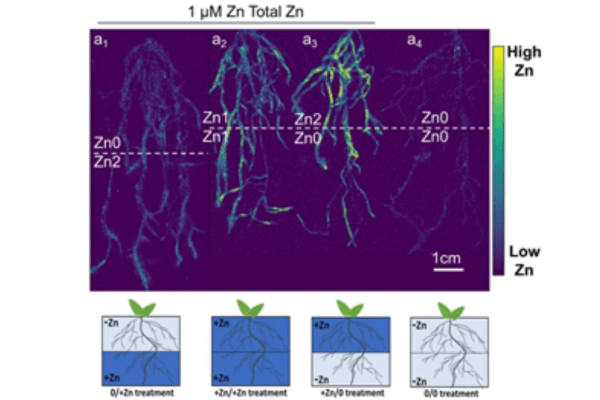
The study employed an innovative transparent soil medium, enabling the simulation of natural soil conditions and precise tracking of Zn distribution within the tabacco Nicotiana tabacum root system. The results reveal a surprising strategy: plants can redistribute Zn between their own roots, moving it from roots growing in Zn-rich soil to those located in Zn-deficient zones. This redistribution alleviates deficiency responses and leads to a reduction in Zn uptake from the environment.
Molecular analyses showed that heterogeneous Zn availability strongly influences the expression of genes involved in Zn homeostasis. The activity of genes encoding a Zn importer (NtZIP4B), a Zn exporter (NtHMA4a/b), and a Zn chelator (NtNAS) was significantly altered. These findings suggest the existence of a systemic regulatory mechanism coordinating Zn allocation based on the overall Zn access perceived by the root system.
The research utilized the advanced infrastructure of the POLYX beamline at the Polish synchrotron SOLARIS, allowing in vivo visualization of physiological concentrations of Zn and other elements (from Al to Cd).
The study was funded by the National Science Centre (NCN) under project no. 2023/51/B/NZ9/02518.
We encourage you to read the full publication:
https://link.springer.com/article/10.1186/s12870-025-07391-z
Fot. Changes in Zn distribution in the roots of plants grown under uniform (deficit and optimum) and non-uniform (split-root systems) access to Zn in transparent soil (hydrogel medium) (Pypka et al. 2025).