

OPUS NCN grant for research on the mechanisms underlying the relationship between temperature and body size in ectothermic organisms
08 12 2025
Dr Piotr Maszczyk, Assistant Professor at the Department of Hydrobiology, Institute of Ecology, Faculty of Biology, University of Warsaw, has received funding from the National Science Centre in the amount of PLN 1,909,562 under the OPUS 29 call to carry out the project entitled “Temperature-dependent predation as the ultimate factor shaping the relationship between temperature and body size in ectothermic organisms”. The project will be implemented in consortium with the Warsaw University of Life Sciences (SGGW).
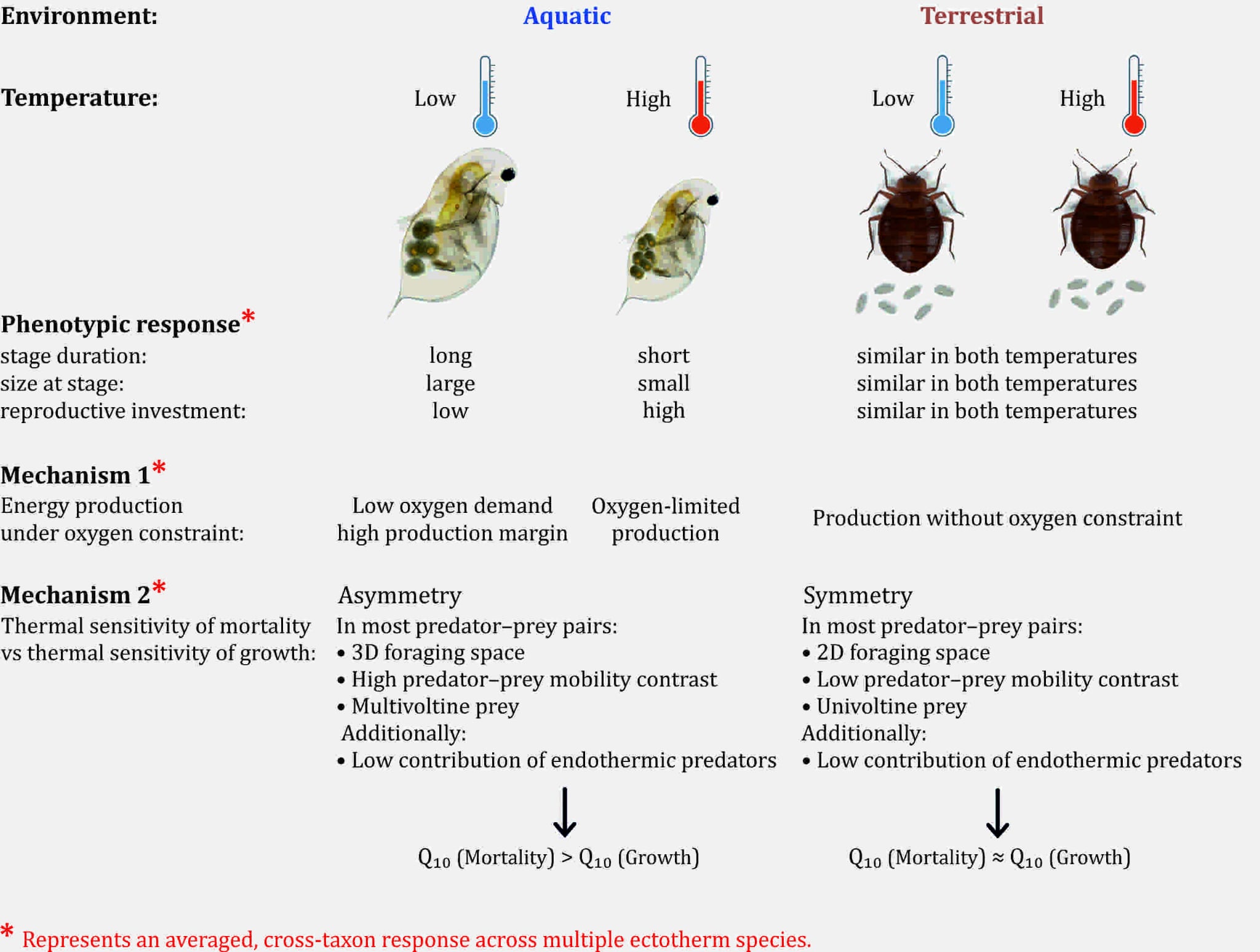
Body size is a key trait determining the functioning of ectothermic organisms. Under conditions of ongoing global warming, understanding the mechanisms regulating changes in body size is of fundamental importance for ecological and evolutionary forecasts. The temperature–size rule (TSR), according to which ectothermic organisms grow faster at higher temperatures but reach smaller body sizes at a given developmental stage, is widely documented; however, its mechanistic basis remains incompletely understood.
The project will analyse two types of mechanisms: (1) a constraint-based mechanism, in which the decrease in body size results from physiological limitations of production under conditions of increasing oxygen and energetic limitation with rising temperature, and (2) an adaptive mechanism, in which TSR is the effect of optimization of life-history strategies by natural selection, such that the combination of growth rate, age and size at maturation, and reproductive investment maximizes individual reproductive success. The main emphasis will be placed on the role of temperature-dependent predation as a selective factor shaping TSR.
To assess the generality of the predation mechanism, it will be examined in various predator–prey systems in aquatic and terrestrial environments, using experiments integrating organismal, physiological and molecular levels, as well as through meta-analysis. It will be tested, among others, whether the stronger TSR pattern observed in aquatic ectothermic animals results from stronger, thermally modulated predation pressure compared with terrestrial systems, arising from the more frequent foraging of predators in three-dimensional space combined with prey foraging in two-dimensional space, greater differences in mobility between predator and prey, and a lower contribution of endothermic predators.
By integrating molecular, physiological and ecological perspectives, the project aims to provide a precise explanation of the dual basis of TSR, production under oxygen limitation and thermally modulated predation, and to improve predictions of the effects of climate warming on the functioning of aquatic and terrestrial ecosystems.
We warmly congratulate on the obtained funding and wish fruitful research and success in securing support for future projects.
Details of the OPUS 29 call are available on the NCN website:
www.ncn.gov.pl/konkursy/wyniki/2025-11-28-opus-preludium